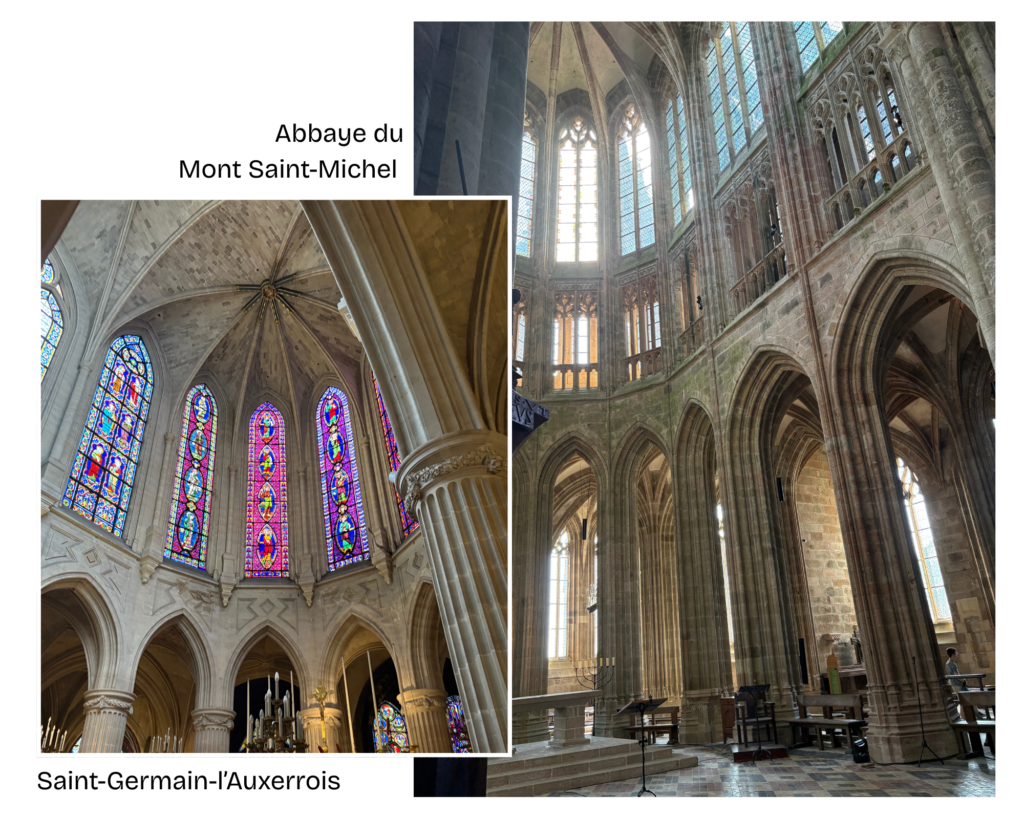
As I have accompanied Ellie on her quest to find the most historic clocks in Paris, I have visited many churches. It’s astounding the number of churches I have been to in the past few weeks, probably more than I have been to in the last five years. As a non-Catholic person, my only connection to churches is to simply admire the beautiful architecture and decoration. Some of the most beautiful buildings I have been in have been Catholic churches scattered throughout Paris. To make my visits more fun, I’ve created a little game: find the Joan of Arc statuary.
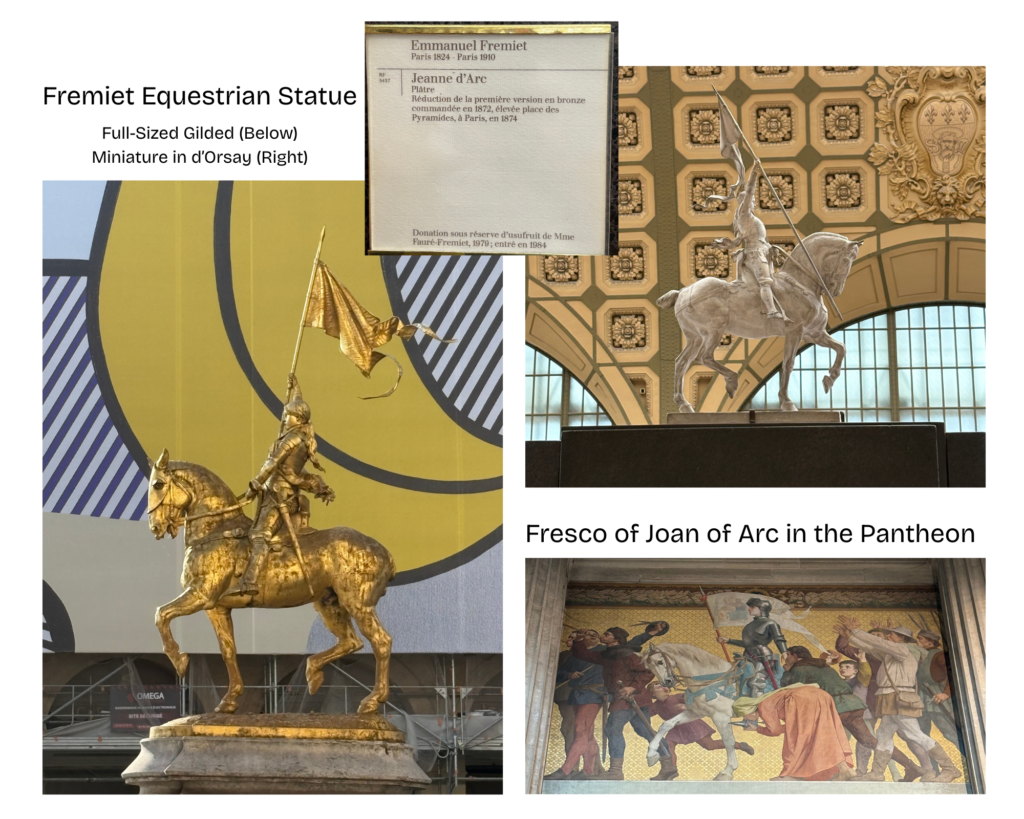
My interest in Joan of Arc depictions in Paris began before our trip started, as I researched various equestrian statues in the city. The statue I was most looking forward to visiting was the golden Joan of Arc equestrian statue located near the Tuileries Gardens. This 1874 statue, created by Emmanuel Fremiet, is one of only two equestrian statues of the saint in Paris (the other is located outside Sacré-Cœur, which we haven’t visited yet), and is notable for having a miniature version on display in the Musée d’Orsay. The dynamic nature of this statue makes it so lifelike and breathtaking, featuring Joan holding a striking and confident pose, and the horse depicted in precise movement. Her presence on a horse is so symbolic of her respected position in French history, as horses have traditionally been used as a status symbol for figures memorialized through statues. She is also featured on horseback in the fresco above the series of paintings telling the story of Joan of Arc in the Pantheon. It was this early observation of the female saint on horseback that piqued my original interest due to the uniqueness of the occurrence.
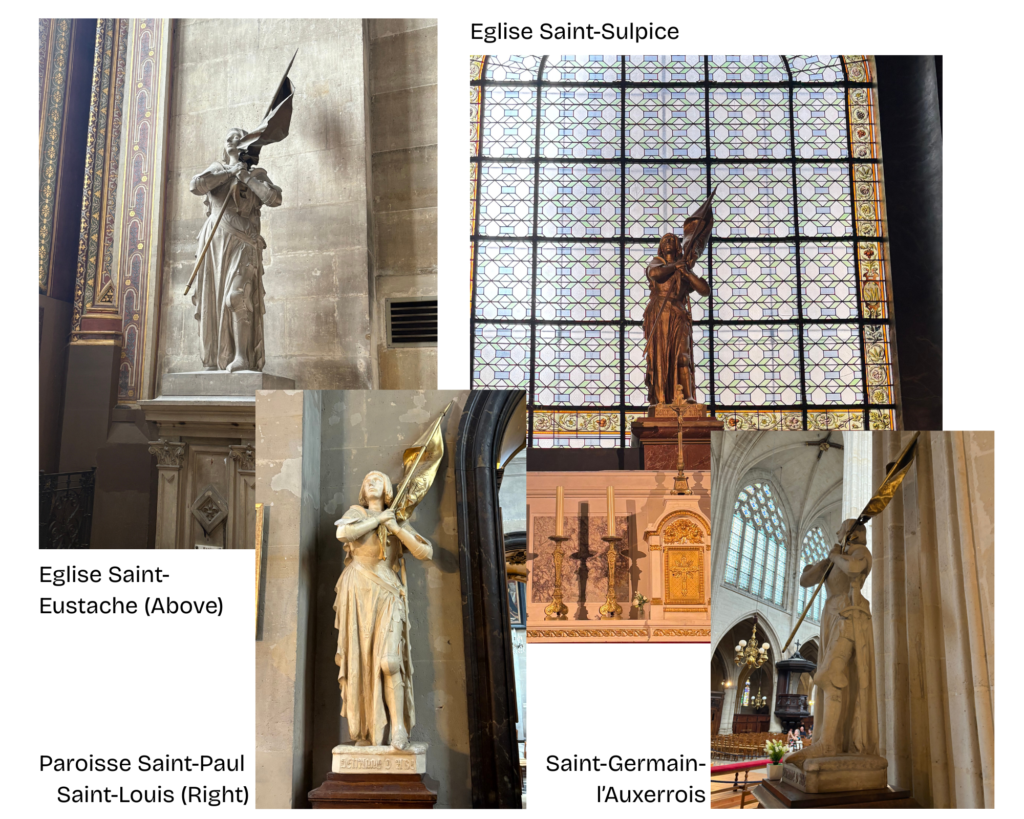
Long-winded tangent on equestrian statues aside, I slowly began to notice Joan of Arc more around the city, particularly in churches. While there are many statues dedicated to female saints in all the churches, Joan of Arc is the most depicted woman (outside of Mary, the mother of God). I would have guessed that Saint Guinevere would be most prominent due to her connection to the city of Paris, but the well-known story of Joan and her role in French history must have had a large impact on the Catholic Church in Paris. She is easy to pick out, with her armor and bearing of the French flag. Her sword is also always attached to her hip, but almost never drawn in the depictions I have seen. The sword seems to be a decoration while she leads with her passion and ability to rally the troops.
The stance most often used features Joan holding the flag to her heart, with the flag softly draped on her shoulder, and her left leg slightly forward, exposing her armor. I have seen this exact pose in multiple churches, including Paroisse Saint-Paul Saint-Louis, Saint-Germain-l’Auxerrois, Eglise Saint-Eustache , and Église Saint-Sulpice. I am unsure which statue is original, but it is safe to assume that they are all replicas of an original statue. This depiction emphasizes Joan’s intense love for France and her preference for using words over her sword, which is fitting for inspiring devotion among the congregation members. There is an interesting use of gold in the different statues, with some, such as the one in Église Saint-Eustache, using no gold, while the Saint-Sulpice statue is entirely gilded. My favorite is the limited use of gold, reserved only for the flag, adding an interesting dimension of significance to the statue.
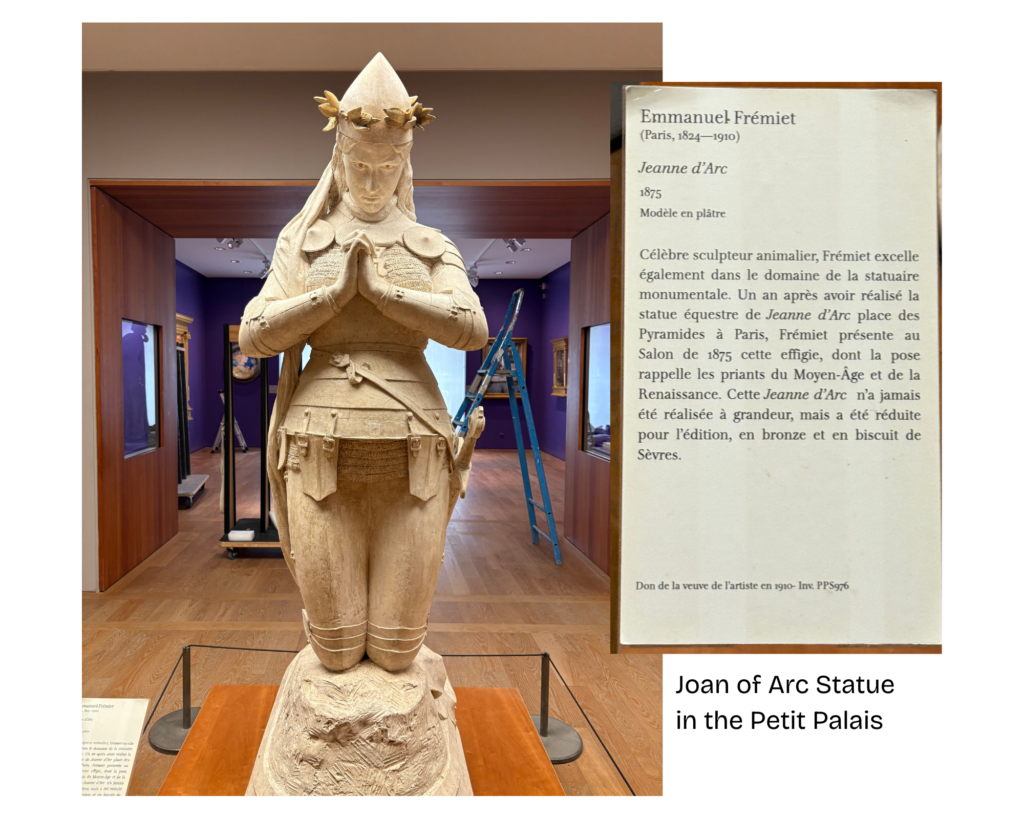
I also ran across a statue of Joan of Arc in the Petit Palais, this time in a position of prayer. The flag is on the ground underneath her, and her head is bowed. Also made by Fremiet, a year after the equestrian statue, this plaster model was never made to the full size as intended, but was meant to emulate the prayer style of the Middle Ages and Renaissance. The headdress is unique to this piece, appearing as a crown of florals, perhaps representing laurels that symbolize prosperity and peace. Overall, it is an interesting contrast to the previous Joan statue created by the artist, which depicts the saint as both a confident, horseback-riding leader in battle and a girl devoted to God above all else.
This contrast is interesting to examine in the context of modern symbolism associated with Saint Joan. She is simultaneously representative of feminism and purity, two ideals that are often seen as opposites. Unfortunately, many right-wing groups have clung on to Joan’s status as a virgin until death, praising her purity and French nationalism, neglecting the other key aspects of her story. On the other hand, feminist groups often rally behind Joan of Arc, seeing her ambition and confidence as something to be praised and followed. She has been used as a figurehead throughout history, most interestingly in the suffragist movement of the early 20th century. The conflicting narrative surrounding Saint Joan is compelling to research and interesting to project onto her depictions across Paris, as she is represented in a broad spectrum of interpretations. As I continue to visit more churches, I am excited to try to spot more statues of Joan of Arc.
Its been really fun getting to be an occasional part of your quest to take photos of all the horse statues, and the Joan of Arc equestrian statue is definitely one of my favorite statues I’ve seen so far. I love how dynamic it is, especially with the waving of the flag in the air. It was also cool to see the miniature version when we visited Musée d’Orsay.
I love your perspective on creating a game out of visiting these incredible sites and your appreciation for Joan of Arc! I also find myself looking for her statues because I find her story so fascinating. It’s a shame that far-right groups have taken her story and adapted it to fit their narratives, but yet still important to acknowledge different perspectives as you have done.