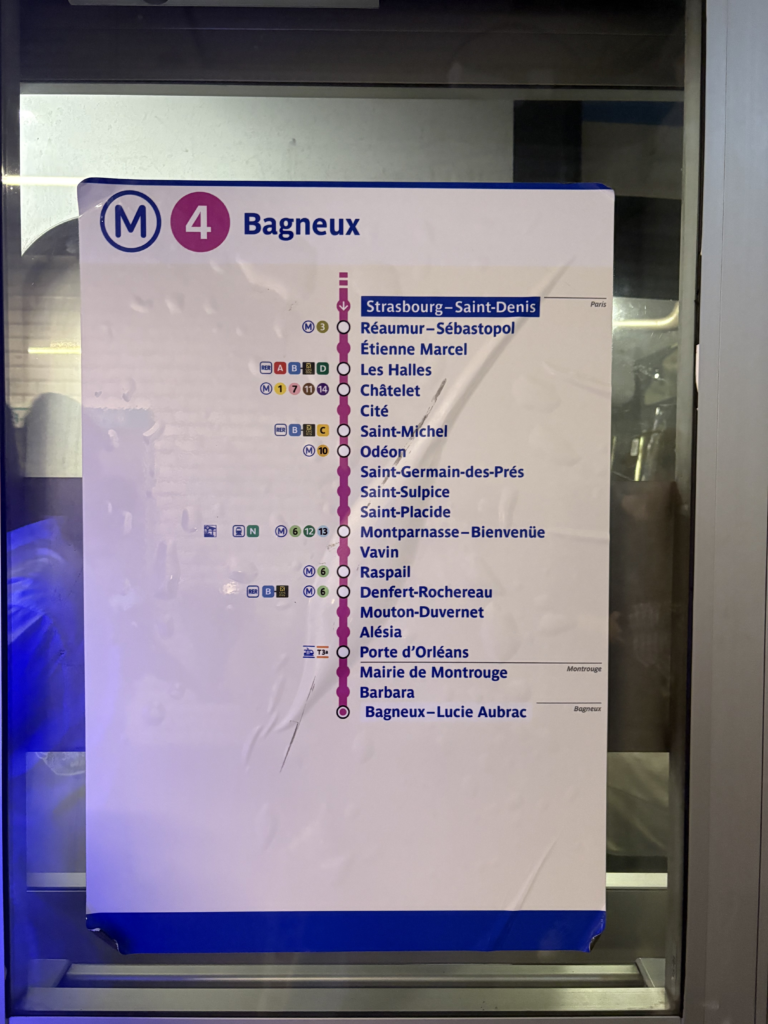
It was a wonderful Tuesday morning when I looked up directions on how to get to our destination for the day, the Musee d’Orsay, and a beautiful message appeared. Metro line four was reopened, a first during our time in Paris. Over the previous two weeks, all signs for the four were covered in red tape, and I only had a vague idea of where the line even went, with only the barest notion that it was causing the RER B to be slightly more crowded. Upon boarding the train and examining the stops, I began to understand why the B had been so crowded, as the two lines largely followed the same path in the city. Thus, I began to appreciate the wonders of a redundant transit system fully.
The hub-and-spoke system commonly found in American cities pales in comparison to the layered, redundant Parisian system. Washington, D.C., a cute design a toddler could come up with; New York City, good luck trying to get to the right place when a line is closed. The Interconnected nature of the Paris public transit system allows the lines to be shut down for repairs while still providing alternative routes and means of getting around the city for those who depend on public transit. Summer is a major time for work to be done on the transit lines, so I have been seeing closure signs throughout the city, but the transit authorities have mitigated the consequences of shutdowns in many ways:
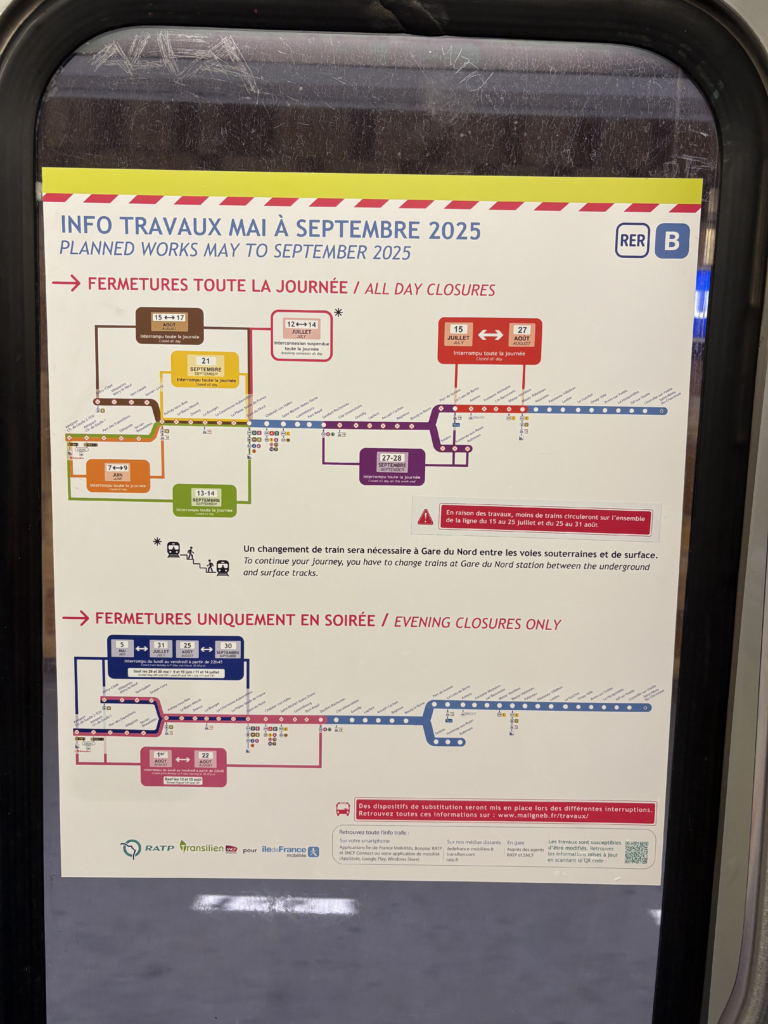
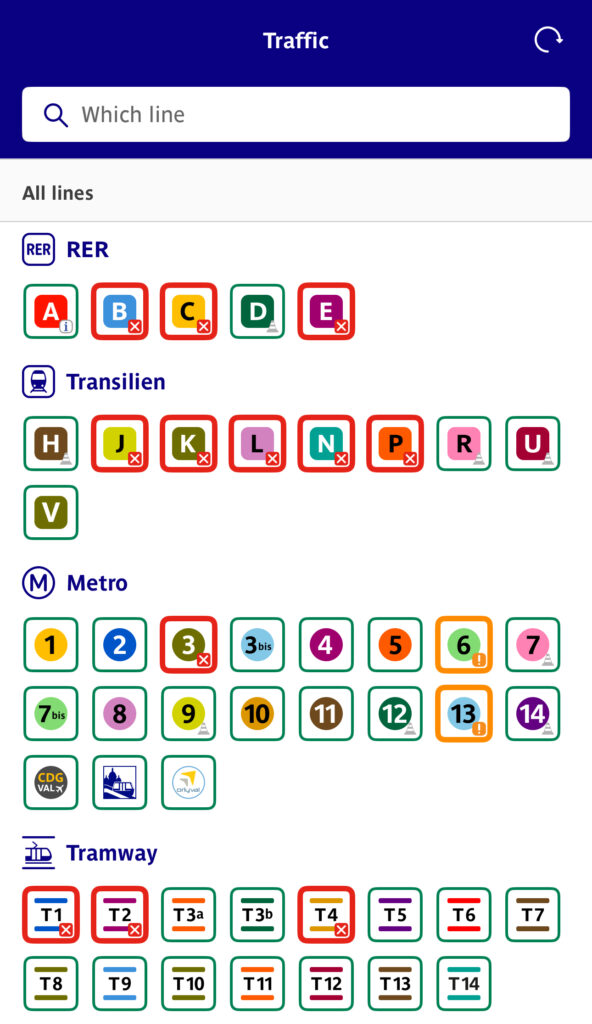
Notices are posted around the stations and in the trains themselves, listing all the closures occurring within a given time frame. Currently, the trains are displaying closures from May through September, giving passengers ample notice of when closures are expected. The signs on the train only announce closures for that line, making them easy to understand and not overly complicated. Closures are also available to view in the RATP app, allowing passengers to get a good sense of closures throughout the city without needing to visit the station itself. I find them a great thing to look at to avoid staring at other people!
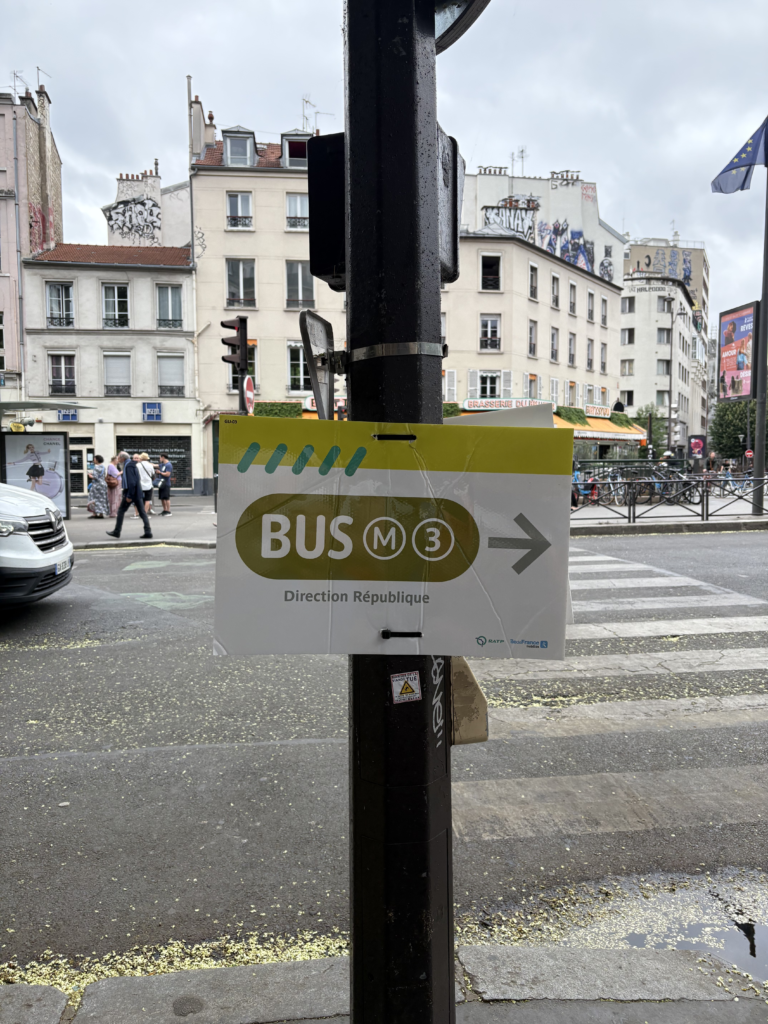
Bus alternatives are also provided to allow passengers not to have to go out of their way to find an alternative route; instead, they can take the same path, albeit on the surface. Because the metro system is built following the roadways, it is easy to replicate the path in a bus form, the only downside being that it may take slightly longer.
Announcements are also given at the stations where you can connect to closed lines, informing the listener that the line is under construction. The announcements are given in both French and English, which is great for tourists who are already struggling to navigate a new transit system and may not be aware of line closures. They also occasionally provide insight into what other lines are available to take to get to the same destination. Along the RER B, many announcements advised taking the B from Denfert Rochereau to Les Halles or other similar stations due to construction on the 4.
I saw how important the existence of redundant transit systems was when both options for travelling were down. During my return from a weekend trip to Normandy, while the Four was under construction, RER B had severe delays due to the presence of people on the tracks between Gare du Nord and Les Halles (where we were getting on). We had no idea if the train was coming, as the board indicated the next train would arrive in an hour and six minutes. As I checked my phone for other routes, I realized that the usually fifteen-minute ride would be more like forty-five minutes to an hour, taking an alternative route. Luckily, a train did come, packed wall-to-wall as can be expected, but as I rode the Metro Line four the next day, I realized that the problem would have been largely non-existent if the four was operational, as I could have just taken that train instead of waiting for the B. It made me truly appreciate the flexibility and options available with a redundant transit system.
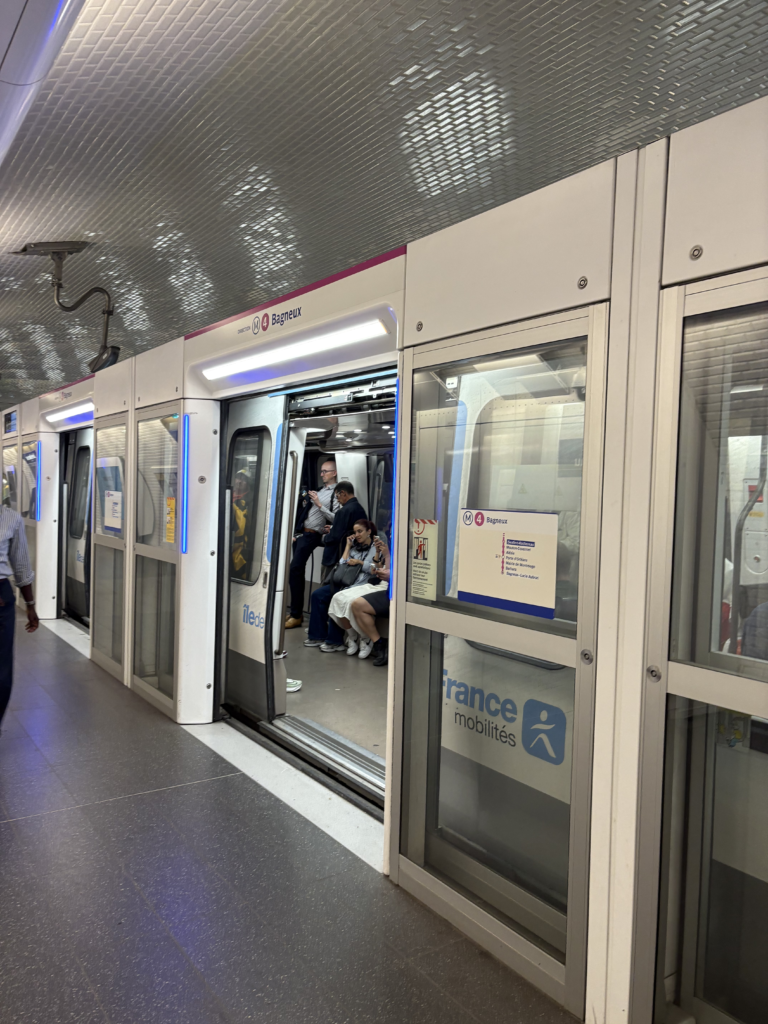
It’s like the trains were smiling with the reintroduction of the four, as on Tuesday, July 15th, all my trains were on time and barely crowded. Of course, my luck returned to normal in the following days as RER B encountered new problems and more delays, but for a day, public transportation was never better.